An introduction to sound, vibration, and making a little room to listen.
Have you ever seen someone use a tuning fork and wondered what those little metal instruments actually do?
Maybe you've heard them mentioned in connection with sound healing, seen a video of someone using them during a wellness session, or simply found yourself curious about how something so small could be part of a relaxing experience.
Let's talk about it.
What Exactly Is a Tuning Fork?
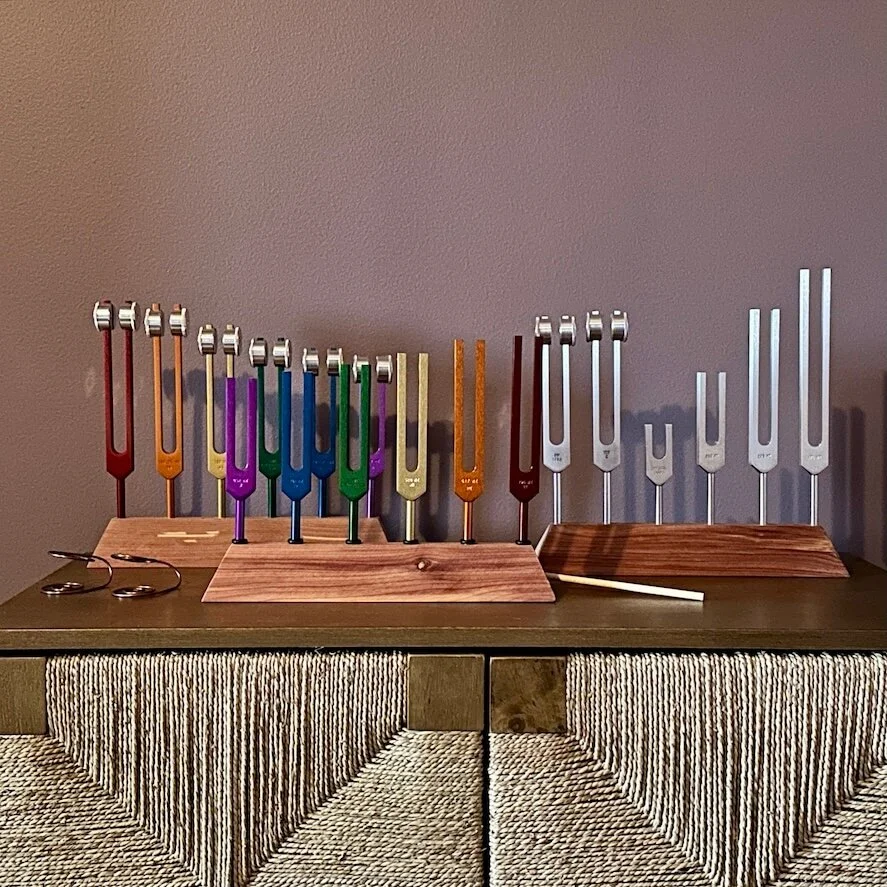
You might recognize a tuning fork from music class. It's a small, two-pronged metal instrument traditionally used to help musicians tune their instruments to a specific pitch.
When gently struck, the prongs vibrate and produce a clear, consistent tone. That vibration creates sound waves that travel through the air and reach our ears. Depending on the type of tuning fork and how it's used, you may also feel its vibration when it is placed in gentle contact with the body.
In sound therapy, tuning forks become instruments for listening, noticing, and experiencing sound in a more intentional way.
And that's where things get interesting.
What Happens During a Tuning Fork Sound Therapy Session?
At Blue Bird Reiki & Wellness in Selbyville, Delaware, a session begins with making sure you're comfortable and have a chance to share any preferences or questions. From there, the experience is shaped around you.
I activate the tuning forks and introduce their tones, allowing you time to listen as each sound begins, resonates, and gradually fades.
Depending on the instruments used, tuning forks can be held near the body so you can hear their tones, or certain weighted forks may be gently applied to appropriate areas so you can experience vibration through touch. How the forks are used depends on the session, and we'll always discuss your comfort and preferences.
There's no special technique you need to master. You don't need to meditate, control your breathing, or concentrate particularly hard.
You can simply rest, listen, and notice what you notice.
Some people find that having something to listen to gives their attention a welcome place to land. Others become aware of subtle sensations, find themselves relaxing, or simply enjoy the experience of having nothing to accomplish for a little while.
Your experience may be different from someone else's, and that's perfectly fine.
Here’s a quick rundown of what happens with a tuning fork sound therapy session:
sessions begin with making sure you’re comfortable
the practitioner activates the tuning forks and introduces their tones while you listen
tuning forks can be held near the body or weighted forks may be applied to appropriate areas so you can experience vibration
you simply rest, listen, and notice

Why Sound and Vibration?
Sound is part of our everyday lives, but we don't always stop to listen.
Think about the difference between hearing music playing in the background while you're answering emails and sitting down to listen to a song you love. The sound might be the same, but your experience of it can be very different.
Intentional listening invites us to give sound our attention. Instead of trying to solve a problem, finish a task, or organize the next ten things on our mental to-do list, we have an opportunity to pause and experience what's happening in the present moment.
Tuning forks offer a particularly clear sound. You can hear the tone emerge, follow it as it resonates, and notice as it gradually disappears. When vibration is felt through the body, it adds another sensory experience to explore.
For some people, this focused listening makes it easier to settle into a quieter state of mind. Others simply enjoy the tones and physical sensations. There is no particular response you're supposed to have.
What You Might Feel During a Tuning Fork Session + How I help those in Delaware.
There isn't one right way to experience tuning forks.
You might notice the sound itself, a gentle vibration, or a sensation where a weighted fork is applied. You might feel relaxed, become aware of tension you hadn't noticed, or find your thoughts wandering less than usual. You might experience an overall welcome sense of ease.
You might also feel very little during the session and simply appreciate having time to rest.
Emotions can surface, too. Sometimes a quiet moment gives us room to notice feelings that have been sitting in the background of a busy day. If that happens, there's no need to force an interpretation or make anything happen. You can take your time, and allow yourself the space to experience your own emotions.
You don't have to feel something extraordinary for the experience to be worthwhile.
This isn't a test, and there's no result you need to achieve.
Are Tuning Forks the Same as a Sound Bath?
Not exactly, although they can overlap.
A sound bath typically involves an immersive listening experience created with instruments such as singing bowls, gongs, chimes, and sometimes tuning forks. The sounds are layered to create a rich environment for listening and rest.
Tuning fork work can be more focused. The tones are often introduced individually, allowing you to notice each sound and, when appropriate, its vibration through the body.
At Blue Bird, tuning forks are one part of a broader sound therapy offering. I also use instruments such as Tibetan singing bowls and a kenari shaker, creating a personalized experience rather than following one fixed formula.
The instruments may differ, but the intention remains the same: to create space to pause, listen, and reconnect with your own experience.
Do I Need to Know Anything About Sound or Meditation?
Not a thing.
You don't need a musical background, meditation experience, or any particular belief about sound or energy.
You don't even need to be good at relaxing. If your mind wanders, let it wander. If you notice the sounds, enjoy listening. If you need to shift position, ask a question, please do.
This is your time, and your comfort matters.
If you have significant sound sensitivity, tinnitus, or another condition that makes sound uncomfortable, let me know before we begin so we can discuss whether and how to adapt the session. You can always ask to reduce the volume, change the approach, or stop.
A Little Space to Listen
We spend so much of our lives responding to what's around us. Messages, responsibilities, conversations, decisions, and the steady stream of things asking for our attention.
Sometimes it feels good to have a little space where nothing is required of us.
That's what draws me to sound therapy. Not the promise of a particular outcome, but the opportunity to slow down, experience something different, and give ourselves permission to simply be present.
Tuning forks are one way to do that. Small instruments, clear tones, gentle vibrations, and a little time to listen.
You don't have to become someone new. Sometimes, you may simply need a little space to reconnect with yourself.

Curious about trying tuning forks?
I'd love to welcome you to Blue Bird Reiki & Wellness in Selbyville, Delaware, and help you explore how sound therapy can help you.